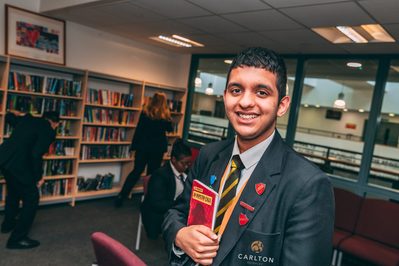
It’s always exciting choosing a new book – Jenny Webb, Trust Director of English and Literacy at Carlton Academy Trust, tells us how she got students involved in deciding which books to buy with money from Department for Education.
An opportunity to bring new books into our schools
We were so delighted to find out that, as part of the National Year of Reading, our school had been allocated dedicated DfE funding for books – ring-fenced money for us to make the most of!
The magic of a real book
There's something profound and magical about holding a book. When you think about it, the physical reality of books is almost surreal: ultra-thin slices of bleached tree pulp, bound into volumes, inscribed with tiny symbols.
But these strange and ingenious objects enable us to carry entire worlds around with us. They hold vast quantities of information, epic tales, journeys and transformations, all in a thing which is small, light and easy to navigate. It’s remarkable, really.
From learning to read, to choosing to read
Reading is central to our work at Carlton Academy Trust and, while our number one priority is ensuring that children can read, the imperative to encourage and empower them to choose to read comes in as a close second.
We want our young people to exist in the presence of real books and feel that thrilling, stimulating, therapeutic magic.
Bringing books within everyone’s reach
Many of the children across our secondary schools in West Yorkshire don't have books in their own homes.
In our opinion, a school isn’t a school unless it's also a home of books. Our schools all have their own librarians and dedicated spaces for books, and we work hard to ensure that these are places where students’ voices and experiences are known and valued.
So, how did we decide how to spend the money?
We asked the children, of course.
All our schools approached this with the same principles, but in ways which suited their unique cohorts. The processes were led in each case by our fabulous librarians.
1.) Surveying students about what they would like to see in the library
In some schools, we held in-person conversations and panels. In others, this was an initial paper or digital questionnaire. We asked students to tell us:
- What we have in the library which they want more of
- What we haven’t got, which they would like to see
- What kinds of books might make them come to the library more often
2.) Forming groups to come together and make choices
We brought together groups of students to help make choices, either drawing on a broad range of voices or focusing on cohorts of students we wanted to see in the library more.
For instance, we spoke to a target group of year 9 boys who don’t currently read by choice. We also had a focus group of girls with SEND, and a group of new year 7 students. They all had really interesting perspectives and helped us to shape our thinking.
3.) Making a final selection
We took many things into consideration but were mostly directed by the choices of the students themselves. In addition, we considered:
- The needs of our cohorts (for example level of challenge, topic, borrowing trends)
- What we already know about our most popular titles, genres and forms
- What gaps in genre, form and topic we have identified
- What we already study in our curriculum and how we might make explicit links
4.) Planning to share books with students
When our books arrive, we plan to have launch events to make sure students know about all the new options and can see how their ideas and requests have become reality.
In some schools, there's a plan to have dedicated ‘private’ launches for small groups of students who may benefit from exploring these new texts in a calmer, more peaceful environment.
We can’t wait to receive the books and see what our students choose to read.
All state-funded secondary schools in England are eligible for this funding, which can also be used for other reading materials including e-books and audiobooks. For more information, see the DfE guidance here.
Leave a comment