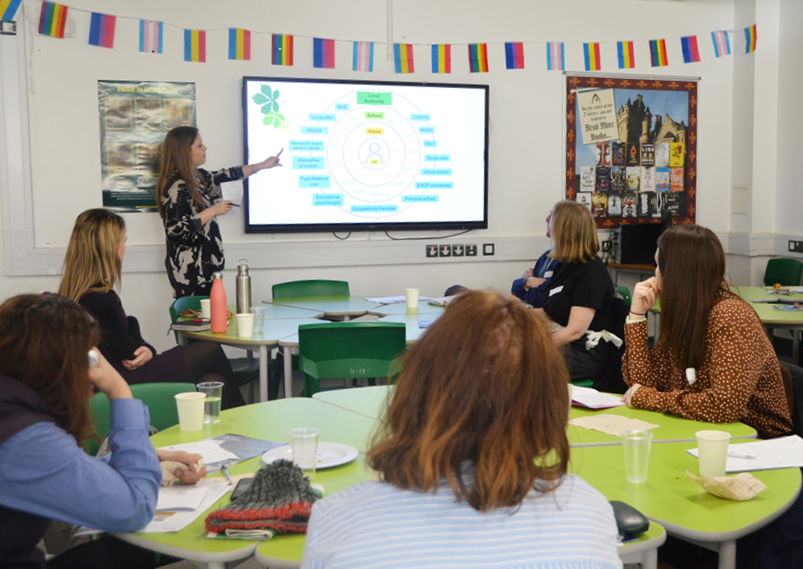
Read how SEND training helped one school improve support for pupils and build staff confidence.
Over the past few years, Chestnut Grove Academy has fundamentally rethought how we approach inclusion. During my time as SENCO, it became increasingly clear that almost every significant pastoral concern eventually found its way to the SEND team, not because they were solely SEND concerns, but because the underlying drivers of behaviour, attendance, safeguarding, and wellbeing were often rooted in unmet need.
As a school with a high proportion of students with additional needs, we wanted to develop a model that would both break down these organisational silos and build inclusion expertise across the wider staff body. This led to the development of our Inclusion Triangle: a three-tiered framework bringing SEND, behaviour, attendance, safeguarding, and mental health under a single model of inclusion. Alongside a comprehensive programme of staff development, this approach has contributed to improved attendance, reduced behaviour incidents and, despite the complexity of need within our cohort, just one permanent exclusion in recent years.
A shared framework for inclusion
The Inclusion Triangle is built around three levels of provision, similar to the model in the SEND reform consultation: universal, targeted, and specialist support.
It enables different aspects of pastoral care to be viewed through a common lens, reducing the risk of teams working in isolation, and provides clarity around roles and responsibilities.
This has allowed us to distribute expertise across the school while ensuring that specialist provision remains available for the students who need it most. We have therefore evolved our approach to professional development to make inclusion a whole-school responsibility.
Tier 1: Universal provision
Tier 1 encompasses the responsibilities of all teachers, tutors, and support staff. We identified a small number of evidence-informed, non-negotiable approaches in every classroom, drawing on research around inclusive teaching, literacy, and metacognition.
Strengthening universal provision has improved outcomes not only for students with identified SEND, but for a far wider group of learners.

Tier 2: Targeted support
For students requiring support different from or additional to universal provision, responsibility moves into the targeted phase.
A key principle of our model is that effective intervention should not depend on a SENCO identifying every need or coordinating every referral. Instead, we have invested heavily in training staff more widely to recognise indicators of need, understand referral pathways, and implement appropriate interventions.
This has enabled support to be both timelier and more proportionate - helping build confidence amongst staff and ensuring inclusion expertise extends well beyond specialist teams.
Tier 3: Specialist provision
By the time a student reaches Tier 3, they require specialist support informed by a thorough understanding of need.
Importantly, specialist provision does not mean that responsibility transfers entirely to the SEND department. We have deliberately developed expertise across our wider leadership structure. Assistant headteachers have undertaken SEND qualifications, leaders have received training in areas such as emotionally based school avoidance and complex mental health need, and staff have developed greater confidence navigating statutory processes and external agency involvement.
Inclusion through a different lens
Perhaps the most significant change has been conceptual rather than structural. We no longer view behaviour, attendance, safeguarding, mental health, and SEND as separate conversations, but as interconnected elements of inclusion. Each sits within the same framework and is focused on the same goal: understanding need and responding effectively.
The most impactful SEND CPD is often not about developing specialist expertise in a small number of people. It is about building a shared understanding of inclusion across the whole school.
Leave a comment